
So…in a sure sign of continuing mental and emotional regression, I decided the other night to accessorize a drunk by watching a little cable…only to foggily re-discover we haven’t had cable in years (my first clue? No suitcase-sized box on top of a TV not made to support an envelope). I had been reminiscing about how much I had enjoyed those early years of cable and the rise of specialty channels catering to narrowcasting desires, and I thought: “Why not watch a little Nick at Nite?”
By Paul Mavis
I know, I know…demon drink. Once someone helped me off the floor and patiently explained that, no, I wasn’t seeing a great red dragon in the heavens, with seven heads and ten horns, and on his heads seven diadems, with his tail sweeping down a third of the stars of heaven and casting them to the earth, but rather something far worse: the long, slow death of set-scheduled linear television. Although such a channel called “Nick at Nite” still exists by name, they clarified, it should really be called the We Only Show Friends / Modern Family / The Big Bang Theory Repeats At Night For People Not Into Streaming Yet Channel.
One of my favorites from that special time of 80s cable “channeling” 60s television―a show that was always guaranteed to stay my big toe on that shotgun trigger―was the now-sadly neglected The Patty Duke Show, the light, sweet teen sitcom from ABC that ran between 1963 and 1966 (squeaked in before Zapruder and dropped out right before the hippie scumbags ruined everything).
Click to order The Patty Duke Show: The Complete First Season on DVD:
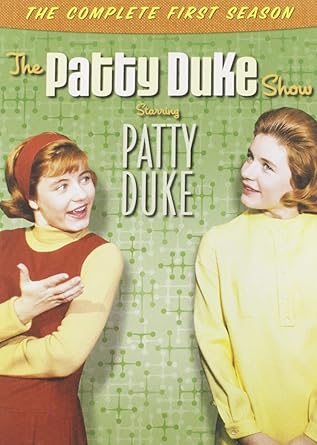
(Paid link. As an Amazon Associate, the website owner earns from qualifying purchases.)
The Patty Duke Show won’t ever appear on any list of the top ten greatest sitcoms, but it’s a charming trifle, a time-capsule back to a (TV-land) time of more innocence and sweetness in network offerings. The cast is superior, particularly Duke (who can do no wrong), with her instantly lovable American teenager Patty Lane. Let’s look at the first season, which aired on Wednesday nights at 8:00pm, from September 18, 1963 to May 20, 1964.

In the upper-middle class borough of Brooklyn Heights, New York, there’s double trouble every day at the Lane household. Typical boy-crazy American teenager Patty Lane (Patty Duke) can’t sit still for a minute: she’s either on the phone, talking to her pals, or rustling up something to eat, or slobbing around in her messy bedroom, or hanging out with her boyfriend, goofball Richard Harrison (Eddie Applegate).
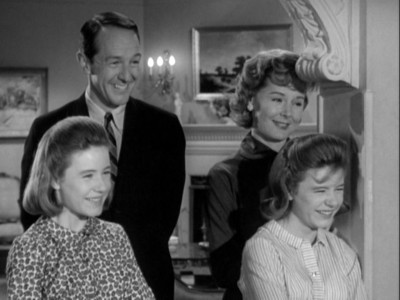
Keeping a watchful eye over her enthusiastic antics are her strict but humorous mother, Natalie (Jean Byron), and her understanding, loving father Martin (William Schallert), who’s a big-wheel editor for The New York Daily Chronicle. Younger brother/pest Ross (Paul O’Keefe) is a formidable foe to Patty’s sanity around the house, particularly when he has a dry wisecrack ready at the drop of a hat―at Patty’s expense, of course.
However, one additional element is added to this utterly conventional TV-nuclear family, one which turns it on its ear: the arrival of Patty’s identical cousin, Cathy (Patty Duke again, of course). Identical because their fathers are identical twins (Schallert portrays Martin’s brother Kenneth in one of the episodes this season), Cathy comes from Scotland to live with her uncle and his family so she can learn about America as her foreign correspondent father travels the globe.

Naturally, sometimes-scheming, slightly-crazy Patty sees the advantages of having an identical cousin (fooling dates, for one). However, demur, intellectual, stable Cathy often steers Patty back on the right track, acting almost like Patty’s conscience whenever one of her schemes backfires.
The Patty Duke Show in its original run was before my time, but it was a staple of my childhood syndicated afternoon line-ups during the early 70s, before it enjoyed a resurgence in 1988 when it played regularly on the then-cool Nick at Nite schedule. I suspect new viewers to the series back in the late 80s enjoyed it as a time-capsule goof (that was the general vibe of the channel, as well as how the suits marketed the channel).

As kids, though, we took it “straight.” We knew it was an “old” show because it was in black and white, and all the slang was hopelessly out of date (it may even have been out of date or phoney in 1963, as well), but The Patty Duke Show occupied that strange syndicated twilight of unreality and acceptance for old shows that so many kids my age experienced. We knew these shows had already come and gone, but once they began endless syndicated reruns, they then existed in some weird limbo of pop culture currency.
Watching the show now, I have too many layers of experience with it (and other shows from that time period, as well) to take it as a “new” encounter, so I’m not sure how it would go over with a viewer not familiar with either it, or with that whole vintage TV gestalt. I can say when Shout! released all three seasons of The Patty Duke Show on disc, my then-seven-year-old daughter Jane enjoyed it just for what it “is,” not “was.”
She didn’t really comprehend that it was a then-40+ year-old series; she just thought Patty Duke was this funny young girl who got into trouble sometimes with her parents―not exactly a foreign concept to her considering how much she liked then-current kid-coms like Clarissa Explains It All and Hannah Montana. Taken on that very basic level, The Patty Duke Show must have been doing something right during its production, because it hits the same buttons today it hit way back when.
RELATED | More 1960s TV reviews
Knowing the backstory of the show, it’s a little more difficult to enjoy The Patty Duke Show as a farcical light romp, considering the genuinely painful childhood that Patty Duke endured during its production. Controlled and isolated by a couple who micro-managed her career and personal life (to the point where she had no life to speak of except in front of the camera), The Patty Duke Show wasn’t even a project Duke was asked to do: she had absolutely no say in anything that happened in her life.

Duke, a genuine child actor phenomenon on the Broadway stage as Helen Keller in The Miracle Worker with Anne Bancroft, had been approached to star in a television series just prior to the release of the movie version of the play―resulting in a performance by Duke that garnered her a well-deserved Best Supporting Actress Oscar (it’s still an electrifying turn, and certainly one of the best child performances ever caught on film).
Created by Sidney Sheldon (right before he created I Dream of Jeannie and then went on to write mammoth best-selling potboilers like The Other Side of Midnight) and William Asher (who would direct the opening episodes of this first season before moving on to shepherd Bewitched with his wife, Elizabeth Montgomery), the youth-oriented The Patty Duke Show would be a natural fit with upstart ABC, which never led overall in the ratings (too little station clearance, for starters) and which could subsequently afford to take chances with a series centered around such a young actress.
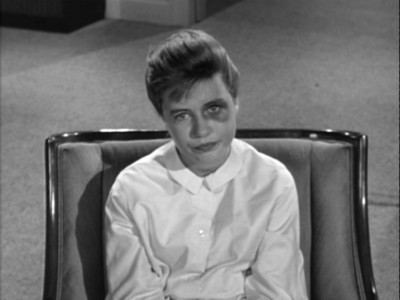
Going into a sitcom with an Academy Award-winner as its lead was a big coup for ABC, and the subsequent hype―along with the final, polished product―helped the series gain big ratings its first time out. Debuting in its series-long time slot of Wednesdays at kid-friendly 8:00pm, The Patty Duke Show held its own against rising NBC Western series The Virginian, scoring 18th for the entire season versus The Virginian‘s 17th overall in the Nielsen’s, with The Patty Duke Show even elevating its lead-in series, venerable The Adventures of Ozzie and Harriet, into the Nielsen’s coveted Top Thirty for the first and only time during its long 14-year run.
With almost every episode of the series written by co-creator Sidney Sheldon (who based the twin characters, reportedly, after experiencing Duke’s real-life fractured personality), The Patty Duke Show remains remarkably consistent in its aims and execution (Shout!’s handy little booklet included with their Season One DVD set makes much of William Asher’s contributions…but director Stanley Praeger directed most of these first season episodes). And while it’s not exactly a laugh-out-loud, frenetic sitcom, it is highly polished and skillful, in a gentle, sweet manner (it’s almost…sedate).
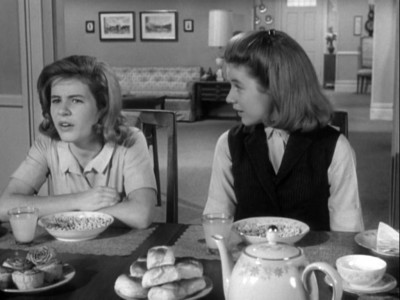
Filmed in New York to take advantage of the then-weak child labor laws when it came to actors (17-year-old Duke would routinely work 12-hour days, as opposed to the strict 4-hour days in Hollywood―nice managers, huh?), a rarity by this point in television when almost everything was shot out in Hollywood, The Patty Duke Show does have an almost imperceptible “otherness” to its atmosphere in that it doesn’t quite look or sound or “feel” like other Hollywood-based sitcoms from that time period.
Maybe that’s where the show’s certain…”stillness” comes from (the use of time-consuming split-screen special effects probably added to the measured tone of the piece: you can’t horse around and be spontaneous if you have to match up mattes and eye-lines). The show’s raucous, almost insane theme song (one of TV’s most memorable, I would imagine) certainly suggests mayhem and unfettered abandon when it promotes the coming complications when identical cousins live together (“YOU CAN LOSE YOUR MIND!” it warns maniacally), but in actuality―at least in this first season―the hijinks are much more measured.
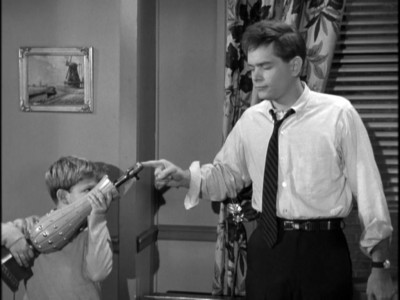
A couple of times the central hook for The Patty Duke Show―identical cousins living together can cause havoc―is utilized, but for the most part, that theme is pushed aside in favor of plots revolving around brash American Patty rushing headlong into a situation (usually featuring Richard or some other school-related activity), with calm, sensible Cathy helping to extricate her in the end. Quite often, that wonderful stereotypical cliché of the American teenager of the late 50s-early 60s―torn between all-American basketball games and getting pinned by a steady boyfriend or girlfriend, and wistfully wishing for “culture” in more sophisticated pursuits, especially if they involve France―is on display here.
After all, that characterization of the cultural dichotomy of the average American teen is present in the very format of the show: “Where Cathy adores a minuet, the Ballets Russes, and crepes Suzette, our Patty loves to rock ‘n’ roll, a hot dog makes her lose control….” It’s unfortunate that either the writers or Duke herself couldn’t enliven this debate through a stronger Cathy character (animated Patty steals the show from almost-dour Cathy in every episode), but this was, after all, a show that Duke states everyone involved with knew was a throwaway.
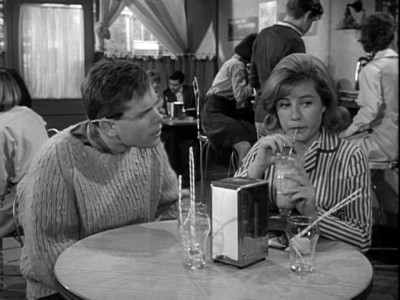
Despite the rightfully-giddy pronunciations that wokeness is dead (it’s gonna take more than Trump, believe me, to stake that vampire), I’m sure most modern critics (and sadly, indoctrinated new viewers) will have a field day with supposed “outdated” modes of representing the average teenager’s life and concerns as they are found in The Patty Duke Show (believe me: if these critics didn’t think it sounded too crass and lowbrow, they’d start their reviews of The Patty Duke Show with, “So who thinks it’s funny to watch some privileged white bitch….”).
Aside from the obvious idealized aspects of the series which are part-and-parcel of traditional sitcom conventions (no “too real,” messy problems that can’t be solved in 25 minutes―and, importantly, none of the boredom inevitably found in everyday life, either), I didn’t see anything here that seemed inordinately fantastic or unrealistic. Patty is portrayed as slightly selfish at times, warm and caring at other times; she’s rowdy, funny, smart-assed on occasion; she fights with her younger brother and looks to do him serious bodily harm on more than one occasion; she’s lazy and she’s a go-getter; she’s sloppy, sometimes scheming…and basically decent and honest.

In other words, she doesn’t sound any different than countless numbers of teens today. The slang may be different, and the pressures from within the family and without may be more acute today (or perhaps just more amplified by a ravenous social media), but the core essence of Patty doesn’t seem too alien to today’s monsters. The circumstances are idealized and quaint and anachronistic, but the emotions are pretty timeless (the episodes usually have a scene where one character connects on an emotional level with another, and it’s very sweetly and sincerely executed).
Patty’s parents, Martin and Natalie, are refreshingly “normal,” as well…within the confines of the idealized TV nuclear family. Martin isn’t above scolding Patty and letting her take her lumps as a lesson hard-learned, while Natalie suffers no illusions about the surprising amount of guile and subterfuge present in the average American teenager―no matter how cute they act on occasion (Byron has a great moment in the opener when, after Martin wonders aloud if she’s being too harsh on Patty, she sneers almost meanly, “No! I don’t care what Dr. Spock says. I say you have to grind them under your heel or else they’ll rise up and get you!” So much for “idealized nonsense”).

The cast is an enormous help, too, with material that sometimes could be described as “slight.” Duke obviously carries the majority of the show’s weight on her shoulders, and she’s just marvelous as Patty. Duke, ferocious in drama even at this early age, proved to be equally adept at comedy. While Duke herself didn’t particularly like her own turn in the series (from all the interviews I’ve read, as well as her bio, if I recall), I found her charming as the rambunctious Patty.
Duke, far prettier than the producers were really willing to let her be here in this series, gets laughs anytime she screws up that lovely face into a petulant or uncomprehending goof while spouting the latest slang (Duke admitted later she had no idea how to play a typical American teen, because of her restrictive personal life). All those young years of theatre training helps with the physical stuff, as well, which she pulls off with her dignity intact (and don’t even get me started about her one song number this season, Tell Me, Mama―a seminal moment in pop TV culture).
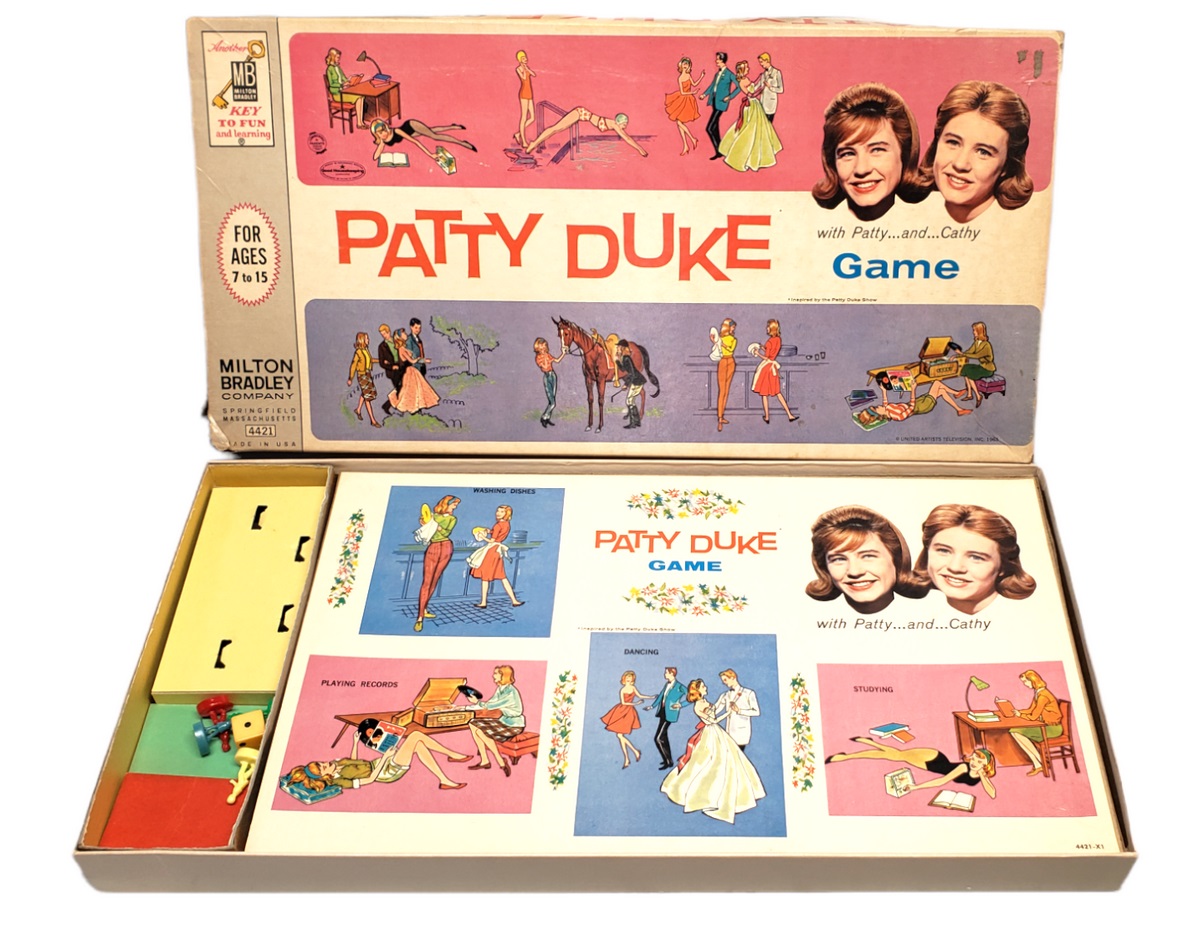
Schallert and Byron are right in synch with the rhythm of the piece; they’re certainly not stretched as far as their talents go, but their professionalism is noticeable in this kind of fluff. And I must say that I was most impressed with Paul O’Keefe as the younger pest, Ross.
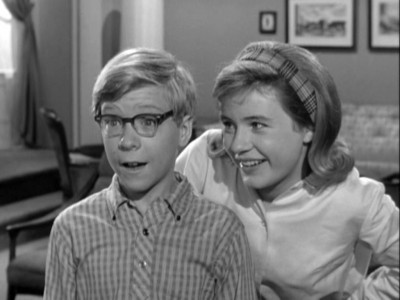
Looking like a pint-sized Woody Allen―while getting off Woody Allen-worthy one-liners with aplomb―O’Keefe just somehow looks and acts like a true New Yorker, with his casual delivery nonchalantly thrown out underneath those appropriately annoying horned-rims. When Martin and Natalie go to see Patty perform in a school play, and Natalie exclaims, almost incredulously, “Patty’s surprisingly good,” Ross dryly returns, “Boy that’s a mother’s love.” Priceless delivery.

Equally funny is Eddie Applegate as goofball Richard. That’s a tough character to essay: he has to be Patty’s romantic boyfriend, but he also has to be the show’s outsized comic relief. It’s an impossible task he pulls off beautifully. Acting broadly, Applegate’s Richard is part ravenously-hungry teen, part slow-witted boob, and half ape, apparently. We’ll see how all of these elements continue to evolve in the next two seasons of funny, light, and perfectly pitched The Patty Duke Show.
Read more of Paul’s TV reviews here. Read Paul’s movie reviews at our sister website, Movies & Drinks. Visit Paul’s blog, Mavis Movie Madness!…but mostly TV.
 Drunk TV