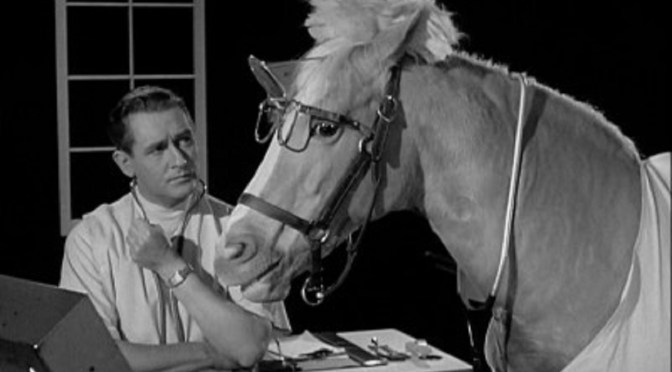
Wilbur: “Read one of your comic books.”
Mr. Ed: “They depress me.”
By Paul Mavis
Well…America’s got an (almost) talking jackass running the whole show, so why not head back for some more talking horse hijinks in vintage TVland. A few years back, Shout! Factory released Mister Ed: The Complete Third Season, a four-disc, 26-episode gathering of the iconic sitcom’s 1962-1963 season―its first slotted into the all-important “prime time” network schedule. Mister Ed is still gently funny in its junior year, still light and entertaining, however…the formula may be starting to show faint signs of wear and tear. Die-hard fans of the show (I most emphatically include myself) won’t care: they just want more Ed and Wilbur; however…this isn’t the series’ strongest season.
Click to order Mister Ed: The Complete Series on DVD:
(Paid link. As an Amazon Associate, the website owner earns from qualifying purchases.)
A synopsis of Mister Ed‘s central story line seems absurd by this point―did you not read our first two season reviews?―but here goes. Young Southern Californian architect Wilbur Post (Alan Young) decides it’s time to move out of the city and into the hills overlooking the San Fernando Valley. Buying a beautifully appointed country house (at 17230 Valley Spring Drive) with his sweet, charming wife Carol (Connie Hines) by his side, Wilbur is looking forward to converting the ramshackle barn out back into his drafting room and office.

But on moving day, both he and Carol discover something in the barn that wasn’t there when they first bought the house: an equally ramshackle palomino horse. Wilbur, remembering his childhood days growing up in a house similar to this one―but without the pony he always wanted―is all for recapturing his youth and keeping the horse, something his wife Carol is against…even after Wilbur cleans and brushes the beautiful palomino. But that act of kindness on Wilbur’s part towards the horse convinces Mr. Ed to finally speak to a human, shocking Wilbur into wild-eyed incredulity (while convincing his bickering neighbors, Roger and Kay Addison, played by Larry Keating and Edna Skinner, that they sold their adjacent property to a certifiable head case).
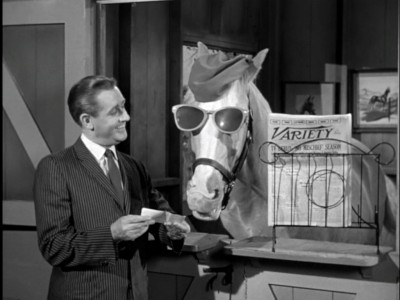
Wilbur wasn’t hearing things: Mr. Ed the horse…can really talk. And to top off that miraculous feat, Mr. Ed is also a bit of a smart-ass and very probably more intelligent than the kind but fumbling Wilbur. And that context sets up the myriad number of gags and misunderstandings that will follow in Mister Ed, because Mr. Ed, out of a combination of stubbornness and laconic, needling perversity, will only speak to Wilbur―no one else. Let the farce begin.

Watching Mister Ed: The Complete Third Season, I was somewhat reminded of the problems I had reviewing later seasons of Hogan’s Heroes (at that verkakta review site DVDTalk, which is now blissfully dead, may they rot in hell. Phewy!). That was another classic 1960s sitcom that locked in early a very tight, rigid thematic structure…and then proceeded to run it into the ground endlessly for several seasons. As I’ve written before in numerous reviews of classic, vintage TV, that déjà vu experience isn’t necessarily a bad thing: the reliable, “repeatable” experience was certainly network TV’s main goal for its viewers (at least by the 1960s), and as long as the content, however familiar over several seasons, was finely crafted and professionally put-over, who cared if Mr. Ed kept whining about Wilbur not paying enough attention to him, season after season?

In my second season review of Mister Ed, I celebrated the fact that it hadn’t changed too drastically from its first go-around because the jokes and storylines were still strong, and the performers still expertly funny. So if the actors are still razor-sharp in their delivery and timing here (which they are, of course), and the same basic situation, with some minor variation from episode to episode, is put into play (Mr. Ed feels neglected by Wilbur, so he does something “human” and bratty that causes not only havoc but which sets in motion Wilbur’s efforts to cover up Ed’s ability to think and talk like a human), the only factor that could possibly disappoint me here would be the writing itself…you know: the gags.
And, to a small degree here…that seems to be the case with this third season of Mister Ed. Having watched all 26 episodes of this set over the last couple of days (hey you tell me what I can do with a bad back and an elbow that only bends when there’s a Miller High-Life in hand), there are only maybe a couple that I can remember right off the top of my head (without referring to my notes). The rest seem fuzzy and vague. And of the ones I remember, none of those are top-flight series’ best efforts.

Now don’t get me wrong: in its third season, Mister Ed is still funny, still charming in a light, child-like way (with that interesting element of sophisticated romantic comedy provided by the married couples, thrown in for spice). I laughed frequently (or at least chuckled); it’s a polished show, and critically, it still showcases whiny, petulant smart-ass Mr. Ed, front and center. But Mister Ed by this point can’t really go anywhere, either, in terms of characterizations or comedic situations. Mr. Ed the talking horse is never going to speak to anyone else but Wilbur, and Wilbur is never going to really evolve and become the smarter, dominant partner here in this horse/man buddy friendship, while the supporting characters are never going to put two and two together and realize that Mr. Ed has to be at the center of all the commotion each week at 17230 Valley Spring Drive.
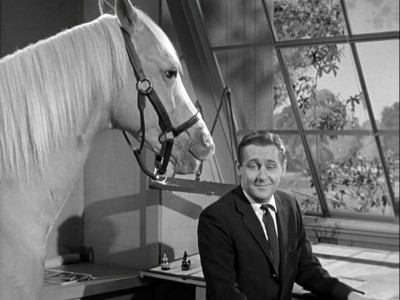
And if the show can’t really grow or change significantly, it’s inevitable that a certain feeling of…sameness will eventually creep into the viewing experience, even if the specific plot details are shuffled around from one episode to the next. That “sameness” is still funny here in season three of Mister Ed. It’s just not as funny as in the previous two seasons.

In my season two review of Mister Ed, I talked about a subtle shift in Mr. Ed’s personality, with the scriptwriters blunting off the edges of first-season hipster smartass Mr. Ed, who bossed Wilbur around with impunity, in favor of a more emotional, more whiny (and more childlike) Mr. Ed, who gets his way now by crying and begging as much as by subterfuge. Ed the manipulator turns into Ed the victim who has to rely much more on Wilbur’s willingness to acquiesce, rather than on outwitting the poor boob in the first place.
RELATED | More 1960s TV reviews

Little glimpses of that Ed peek through now and then, such as Ed wishing he could see his girlfriend Flossie in a black saddle (Wilbur The Masher), or stating his latest flame has a figure that could grace the cover of Playhorse Magazine (Working Wives), or begging Wilbur not to cut him off cold turkey from the apples he’s become addicted to (The Price Of Apples). That Ed is flat-out perverse, and the writers used to love suggesting some hidden world that Ed inhabited―a very adult world―that Wilbur was oblivious to (in Ed The Zebra, Ed proudly states, “I was born a nudist, and I’ll die a nudist.”). However, that earlier Ed is largely gone here, replaced by an Ed that’s frequently either willful like a child (still funny), or repentant and sentimental and blubbering like a child (funny…but not as funny).

Good episodes this season include (and again: this third season is funny…even if I sound sorta grumpy about it) the season opener, whose title says it all: Ed Gets Amnesia (I’m waiting for that dissertation on television’s most popular malady, complete here with its most popular TV remedy: a coinciding bonk on the head). Wilbur The Good Samaritan has a good roundabout with both Wilbur and Roger getting stuck up on a roof…all due to Ed, of course. Ed And The Allergy shows off Larry Keating well as he runs through some funny (and now fondly-missed) mother-in-law jokes.
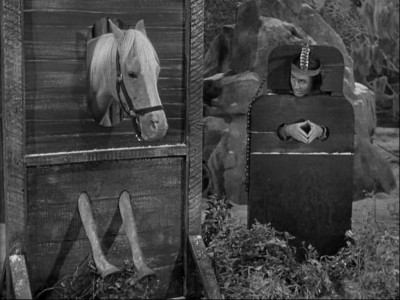
Wilbur In The Lion’s Den is a fan-favorite, with some agreeably nonsensical moments as Wilbur gives character actor extraordinaire Charles Lane some pause as Wilbur keeps bumping his business commitments to fly a kite with Ed. Ed the Pilgrim is a funny spoof on the first Thanksgiving (I love it when Kay takes Roger’s money―he’s in the stocks―for a sale on spinning wheels). Hans Conreid is funny, as usual, as a freeloading impressionistic sculptor in Ed And Paul Revere. Wilbur The Masher gives the talented Alan Young a chance to work out his numerous double and triple-takes in this cute, well-constructed episode.

Big Pine Lodge is a fast-moving little farce as Roger gets fleeced at the card table, and Ed helps Wilbur to cheat back the dough. Working Wives is one of the season’s better offerings, including a funny bit with Young trying to iron the laundry, and Ed hypnotizing that dope Wilbur. The Price Of Apples escalates nicely into fantasy as Ed acknowledges he’s a junkie for Roger’s apples (listen to him plead like a hype for his fix), while Wilbur dresses in fatigues to cross No Man’s Land (complete with barbed wire and search light) to reach Roger’s beloved apple tree.
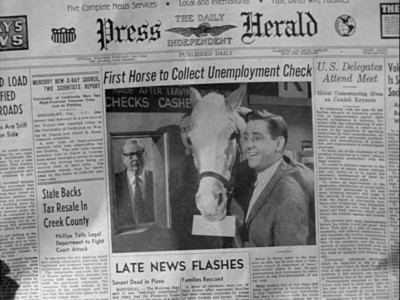
Doctor Ed is a silly-but-fun spoof on all the doctor shows that were so popular on television at the time (check out Ed’s “Dr. Zorba” wig), while Unemployment Show will no doubt crack up a lot of viewers today (for all the wrong reasons) as Wilbur and Ed openly commit welfare fraud (Ed even gets a fraudulent Social Security card)…while still winding up with some cash. Only in Hollywood California…and everywhere else (when Ed first thinks he can’t get disability and unemployment benefits through a faked injury, he mournfully intones, “Four weeks of work down the drain.”).

Encouraged by Mister Ed‘s ratings’ performance the previous two seasons, CBS chanced a prime-time slot for the sitcom this 1962-1963 season, at 7:30 on Thursday nights…where it failed to crack the coveted Nielsen Top Thirty. While suffering no direct competition from NBC’s contemporary western misfire, Wide Country, with Earl Holliman and Andrew Prine, ABC’s “iron horse” performer The Adventures of Ozzie and Harriet, along with a night of kid-friendly fare that included The Donna Reed Show, Leave It To Beaver, My Three Sons, and McHale’s Navy, made it tough for Mister Ed to crack its intended demographic.
It didn’t help that Mister Ed‘s lead-out, slowly-fading Perry Mason, wasn’t a good match for the already tuned-in kiddie/family audience (CBS should have just left Mister Ed on Sunday, bumped up into the failing Dennis the Menace 7:30pm slot, inbetween Lassie and The Ed Sullivan Show. It would have killed there). For its fourth season, CBS would send Mister Ed back to the minors, to its old, reliable Sunday 6:30 timeslot.
Mister Ed: Season 1 review
Mister Ed: Season 2 review
Mister Ed: Season 3 review (You are here)
Mister Ed: Season 4 review

Read more of Paul’s TV reviews here. Read Paul’s film reviews at our sister website, Movies & Drinks.
 Drunk TV
A great piece of storytelling, Paul. About the fading Perry Mason. I sat with Raymond Burr in Toronto while he was doing Underground, a play at The Royal Alex. Burr said, the series was over after the fifth season, but CBS for whatever reason kept throwing money at us, so we went for an additional four seasons. Other things Burr, a very nice guy commented on: I hated the show, not because of the cast or crew, all of whom were very nice, but because they got to go home and I was stuck learning all that legal jargon.
LikeLike
I love your stories, Barry!! Keep ’em coming!
LikeLiked by 1 person