
“We sure are going to miss good ol’ Mr. Wilson.”
By Paul Mavis
Sooo loooooooooong, Mr. Wilson. If you’re like me, the current sad state of affairs on every conceivable level of human existence makes me run to vintage TV discs like Dennis the Menace. And yes of course I know that’s denial and escapism (my two favorite hobbies, after drinking and whoring), and yes, I’m well aware that living in the past is potentially perilous for your mental state (…like it’s healty to embrace the verkakte reality of today’s world, you morons), and no, of course I don’t believe things were perfect back when Dennis the Menace was originally airing. However, at least in terms of entertainment for entertainment’s sake…they most definitely were better. No question (you can always take your counter-argument and ram it straight up your Oppen-Barbie hole if you disagree).
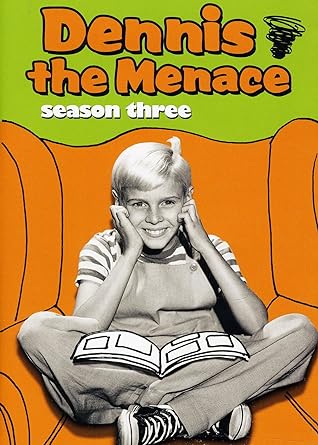
Click to order Dennis the Menace: Season Three on DVD:
(Paid link. As an Amazon Associate, the website owner earns from qualifying purchases.)
A few years ago, Shout! Factory released Dennis the Menace: Season Three, a five-disc, 38-episode (yikes!) collection of the series’ 1961-1962 season. As fans of the series know, season three saw the death of “Mr. Wilson” co-star, Joseph Kearns. Despite the comedic chops of his formidable replacement, Gale Gordon, the handwriting was already on the wall for the series when George Wilson suddenly just…disappeared one day from Elm Street, never to return. Dennis the Menace, this third go-around, is still tightly written and expertly produced, with numerous series-best episodes, but it’s obvious, too, that Dennis will soon be getting too big for those britches.

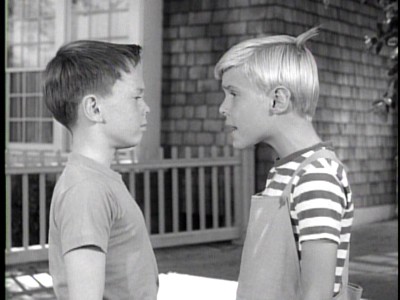
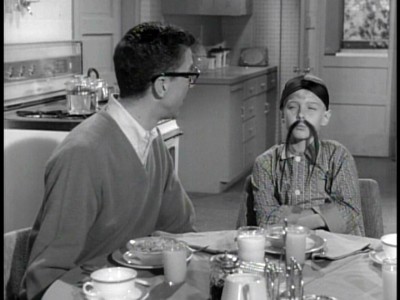
Suburban Hillsdale, America, circa 1960. If you round the bend on Mississippi Street, you won’t have to get too close to 627 Elm to hear a strident, “Helloooooooooooo, Mr. Wilson!” called out by little Dennis Mitchell (Jay North). A rambunctious, inquisitive, tow-headed walking disaster zone in stripped shirt and overalls, Dennis means well, but this red- blooded, all-American boy simply can’t help but lay down a path of destruction wherever he goes…particularly when he visits “good ol’ Mr. Wilson” (Joseph Kearns), the Mitchell’s next-door neighbor. Retired to the good life of 1950s suburban America, George Wilson wants nothing more than to putter around his house with his various hobbies, including bird watching, coin collecting and especially his garden, before settling down every afternoon for a quiet snooze on the couch.
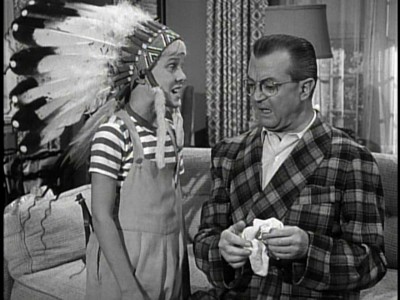
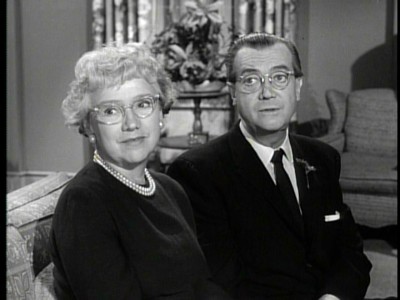
Unfortunately, Mr. Wilson is frequently driven to gulping straight out of his nerve tonic bottle, such is the ruckus caused by hero-worshipping Dennis, who likes Mr. Wilson so much that he’s very probably going to kill George with hyper-kindness. George’s saintly wife, Martha (Sylvia Field), thinks Dennis a dear, sweet little boy, but even she knows there are times when Dennis shouldn’t be around grouchy George…and those are precisely the times that Dennis strikes with completely innocent mayhem.
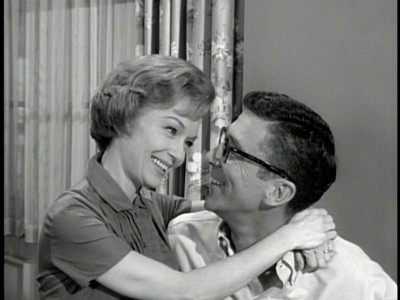
The parents of such a child could rightly apply for sainthood, too; however, engineer Henry Mitchell (Herbert Anderson) and lovely housewife Alice (Gloria Henry), get exasperated with Dennis, as well—until they realize he’s just a boy with good intentions…and low impulse control skills (remember those? They’ve been drugged and bullied and shamed out of existence today). Rounding out the gang are Dennis’ good-natured, willing best friend Tommy (Billy Booth), and that “dumb ol’ Margaret” Wade (Jeannie Russell), who is forever trying to wrangle a horrified Dennis into playing house as her “husband.”
RELATED | More 1960s TV reviews

This season, when George suddenly “goes East” on a trip and/or to “settle an estate,” his brother, writer John Wilson (Gale Gordon), comes to stay at George’s home…where he becomes the latest target of towheaded Dennis’ killer friendship.
If you were a kid like me growing up back in the ’70s, you had no idea about the “reality” of television or its stars. You might read an Earl Wilson column about Archie Bunker bitching for more money, or catch Rona Barrett on Good Morning, America discussing the latest contretemps on the set of Laverne & Shirley.
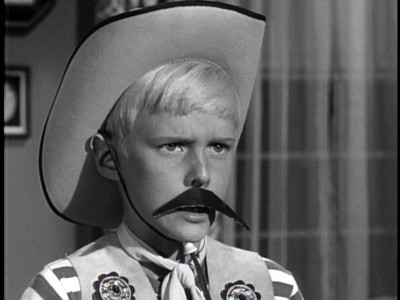
However, if you wanted to know what happened to the first Mr. Wilson on an old show like Dennis the Menace, you were probably out of luck: no internet to instantly look up fifty stories (and fifty conspiracies) on his death, no serious history books on television in the local library, and the most you’d probably get out of your parents, if they remembered, was that he died and that was it. In a weird way, that less-obsessed, pre-media crazed time contributed to that almost dreamlike feel TV had back then for us (or at least me); television just…was for kids.
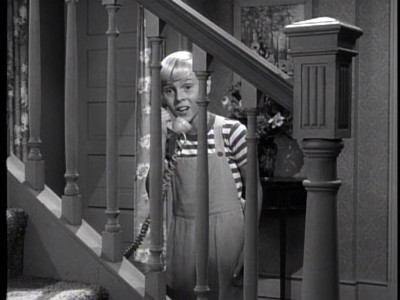
It existed in this strange world of old and new shows butting up against each other without rhyme or reason, and if one day the old Mr. Wilson was replaced with a new one, you wondered about it…but somehow on some weird level it made sense because you knew deep down none of any of it made sense. And you weren’t going to get any answers, either. You just experienced this warped reality. You didn’t look for explanations.
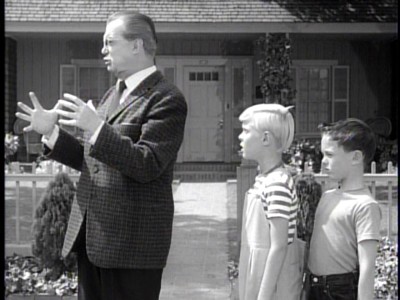
Of course today, that’s all different. Now, if you even watch network television, you can find out anything about its “stars”…and that’s why they hold almost no weight with viewers: there’s no distance, no magic. With the internet, you can easily look up all the particulars of Joseph Kearns’ death from a cerebral hemorrhage on February 17th, 1962, and you can speculate on blogs with hundreds of other TV fanatics about whether or not his strict Metracal diet (a liquid diet drink) was the cause, while gabbing about thousands of other equally “juicy” TV stories (Jay North’s supposed abuse on the show is one of classic TV’s all-time biggies).
But back in the early seventies, watching reruns of Dennis the Menace as a kid, Mr. Wilson was there one day, and the next day he wasn’t, and you wondered about it for five minutes before you just let that shadowbox dream-maker carry you along blinking into new fantasies. After all, you could always see him again when his episodes cycled through the syndication roster.
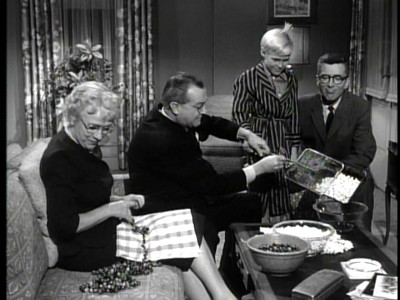
Truth be told, that knowledge of Kearns’ passing does set up a rather morbid curiosity in the viewer while watching this third season of Dennis the Menace. Of course there’s nothing in any of the cast’s behavior here to suggest some weird occult predestination of Kearns’ fate (although how spooky is the coincidence that Where There’s a Will, the episode where Mr. Wilson makes out a will and leaves everything to Dennis, was the last episode to air before Kearns’ own death, just six days later…?).
And Dennis the Menace being a typical model of Hollywood television production efficiency, there’s not the slightest trace of acknowledgment from the remaining cast, on any level in the subsequent episodes, that the show’s co-star has actually and for real, died. Everyone moves on in that supremely odd TV world, as if nothing has happened. That doesn’t stop us from looking for signs, all the same…but they’re simply not there.

Getting past that vague shadow that hangs over the experience of watching season three of Dennis the Menace, just as with seasons one and two, the quality of the episodes is consistently high…if perhaps (just a tad, perhaps), played out. Silly but ingenious plots work out with almost metronomic precision, yielding big laughs from the expert cast.
Episodes like Mr. Wilson’s Safe (where Dennis has to be hypnotized to remember the combination to George’s new wall safe) or Dennis and the Pee Wee League, where George uses psychology to get the boys to transfer their hatred for cello lessons, dancing with girls, and washing, to the baseball, for big runs (did Bill Lancaster watch this before writing The Bad News Bears…because it’s pretty similar), seem slight and even inane at first glance, until they build and build cleverly from one topper to the next.

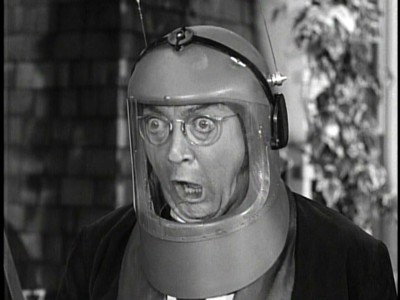
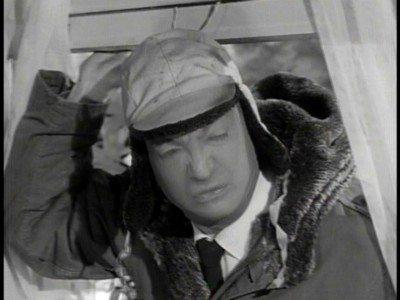
Indeed, that expert situational/slapstick “build” is a hallmark of Dennis the Menace (and many other classic sitcoms from this era), with the various script writers coming up with a seemingly endless supply of ever-increasing mishaps that grow into a major calamity—with Mr. Wilson almost always the sufferer. The season opener, Trouble From Mars, has Mr. Wilson accidentally putting on Dennis’ space helmet and getting it stuck, leading to the fire department eventually raiding his house.
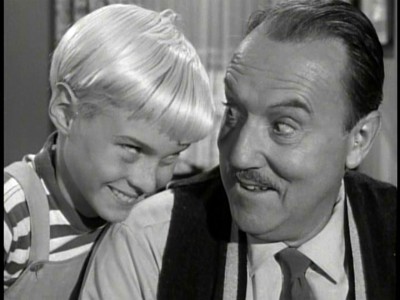
The Fifty Thousandth Customer, a beautifully constructed episode, has Mr. Wilson building himself into a frenzy to be the 50,000th customer into crabby Mr. Finch’s (Charles Lane) drug store, the winner getting a five-minute shopping spree…with of course Dennis beating him to it. The show tops this by having Dennis best the stingy Mr. Finch—who stored everything of value on high shelves—by smart Dennis climbing the walls and throwing everything into a hammock. The script has Dennis sweetly giving Mr. Wilson everything he wanted (there’s genuine affection from North to Kearns in their scenes together…or at least it looks that way).

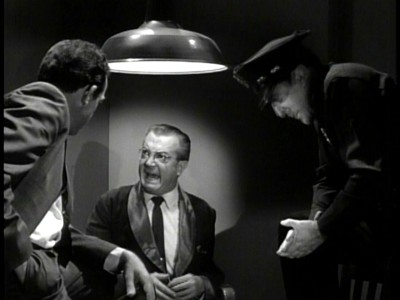
A Quiet Evening finds possible Dennis replacement Seymour (Robert John Pittman) causing havoc with babysitting George by spending his valuable dime in a candy machine (the subsequent events are expertly staged, culminating in a hilarious third degree of George by the cops, a la Dragnet). The Man Next Door is another precisely-designed farce, with everyone suspecting each of being the notorious neighborhood thief (veteran comedy director Charles Barton, who again directs almost all the episodes here this season, is a master at such simple yet effective comedic staging).
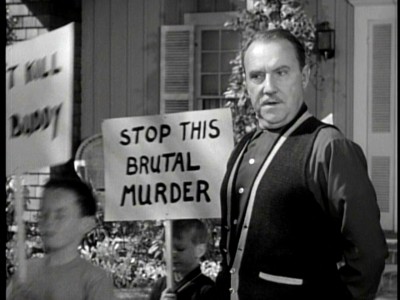
Television historians (blech) take note: Calling All Bird Lovers, a delightfully bizarre entry from Russell Beggs where some hepcat musicians mistake one of George’s bird call concerts for a jazz session, has what has to be one of the first unmistakable drug humor jokes in a network sitcom…on Dennis the Menace, no less (after one of the squares flips out, the jazz enthusiast wonders, “I don’t know what that cat was taking…but I sure would like to have some!”).
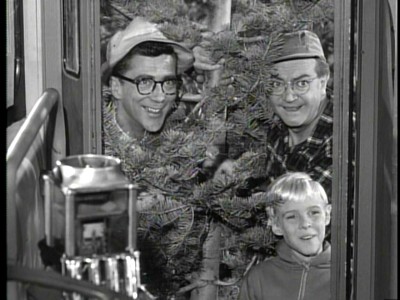
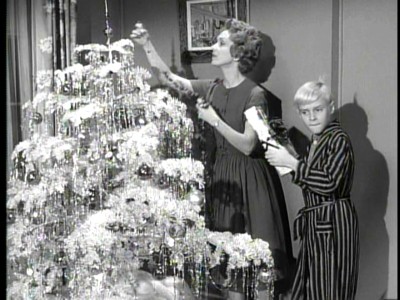
And best example of the “build” here has to be my favorite episode this season, Keith Fowler’s and Phil Leslie’s The Fifteen-Foot Christmas Tree. Here, George takes it upon himself to dismiss the Mitchell’s puny, spray-painted tree so he can take Dennis and Henry into the woods to chop down a real Christmas tree. Of course, the disasters begin almost immediately (he breaks the ax handle on the first swing), before some stray passersby in the woods scam them out of twenty bucks, saying they own the property (hilarious), before the men are trying to get the tree on a bus because they lost their car keys (I hit the floor when the drunk woke up on the bus, peering through the tree branches that surround him, thinking he’s in the woods). The sight of George’s final creation—a hideously mangled abomination of a Christmas tree—is priceless. And of course, Dennis repeats his Christmas tradition by sweetly singing Silent Night at the end of this genuine work of TV comedy art.
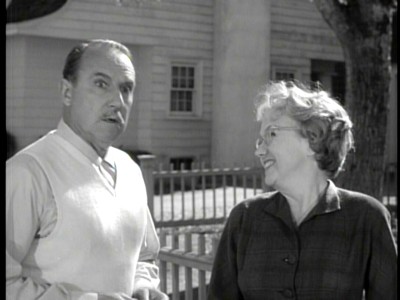
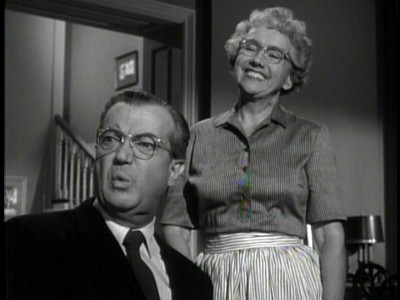
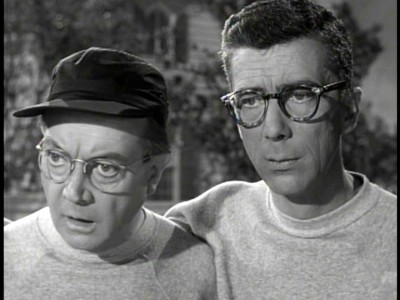
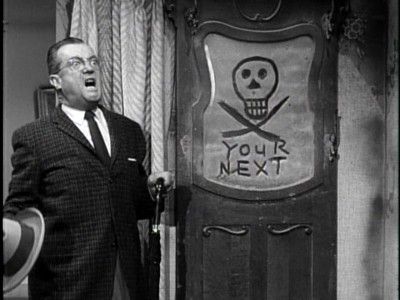
Of course, no review of Dennis the Menace‘s third season would be complete without mentioning Kearns’ replacement, Gale Gordon. You can see the producers scrambling to maintain their production schedule after Kearns’ unexpected demise when they plug in first Willard Waterman as grocer Mr. Quigley into George’s shoes (to no effect: Waterman was priceless as a supporting player, but he fades in the long run), and then Edward Everett Horton as George’s Uncle Ned (he was introduced in an earlier Kearns episode).
Once Gale Gordon comes in, the series finds a beat again—not the same as Kearns’ beat, and frankly not as good as his, but a beat nonetheless, with the producers probably feeling that Gordon was the way to continue with the series. As a huge fan of Gale Gordon’s on the various Lucy Show incarnations, it’s a pleasure to see him here, looking sleek and smooth, with his silky delivery that gives way to brief explosions of rage that are quickly smothered. He’s a gem, as always, and probably more technically proficient an actor and comedian than Kearns.
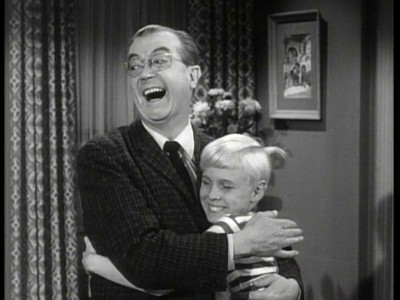
But importantly: he’s simply not Kearns, and it’s difficult to feel any of the connection one felt between Kearns and North here. Understandably, Gordon was probably feeling his way through an enormously difficult situation, knowing he was an outsider in a production “family,” and that his continued presence would eventually lead to another regular, Sylvia Field, being let go. We’ll wait till the fourth and final season to fully evaluate him as the “new” Mr. Wilson, but as for these few last episodes of season three, Kearns is sorely, sorely missed.
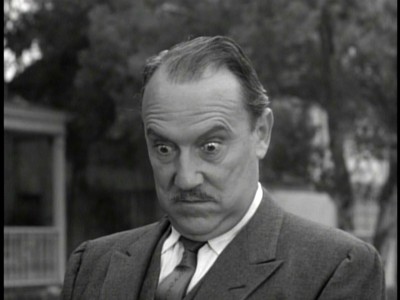
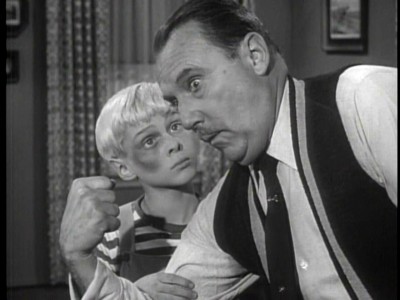
It’s certainly possible that even though it took most of the season for Kearns’ remaining episodes to play out, the news of his death in mid-February could have had a negative effect on Dennis the Menace‘s ratings (like all those kids that cried with they saw the headlines that Superman‘s George Reeves was dead). Just as likely, Dennis‘ direct competition—NBC’s Walt Disney’s Wonderful World of Color at 7:30—was to blame, as well, for the former sitcom’s 11th Nielsen position tumbling to a still more-than-respectable 17th for this third season (no doubt aided by CBS sandwiching the sitcom comfortably between 15th place Lassie and 19th placer, The Ed Sullivan Show).
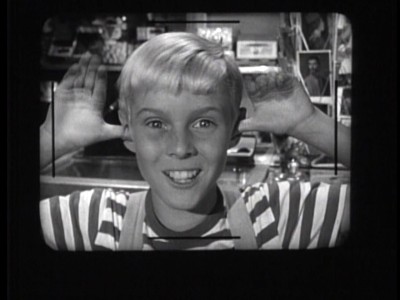
ABC’s adventure series, Follow the Sun, was no serious threat, but NBC’s lure of Disney in color, followed by a hip sitcom, Car 54, Where Are You? (anchored by an equally hip cartoon, The Bullwinkle Show at 7:00pm, and followed up with the giant killer, Bonanza at 9:00), was sure to siphon off some the kiddies (as well as the adults who might have wanted to avoid answering any uncomfortable questions like, “If Mr. Wilson died like it said in the papers, why is he still on TV?”). The following year, Dennis the Menace would drop out of the Nielsen Top Thirty altogether, pole-axed by the loss of Kearns, the rapid maturation of Jay North, the continued presence of Walt Disney…and a hip Flintstones spin-off for the kids, The Jetsons, over on ABC.
Read more of Paul’s TV reviews here. Read Paul’s film reviews at our sister website, Movies & Drinks.
 Drunk TV
Gloria Henry is my girl. Gene Autry’s leading lady in The Strawberry Roan, and Arthur Kennedy’s love in Rancho Notorious. In the Autry film, she was fine, but in Rancho Notorious, outstanding.
LikeLike
No; anonymous, me — your friend Barry Lane
LikeLike
Hahaha…I knew it was you, Barry!
LikeLike
Love love LOVE ‘Deniis The Menace’
I am also a huge Lucille Ball fan, several Dennis regulars appeared on I Love Lucy’ as well.
LikeLike
I just wondered what happened to the first Mr wilson. I ended up reading the whole thing. You’re quite a good writer. 🌈
LikeLike