Can you imagine the poor bastard trying to pitch The Patty Duke Show today, as is?
“She’s White? Nix that! Wealthy? Fine…as long as Dad’s a greedy capitalist criminal. Her brother’s a pest? Good, good―as long as he’s a pervert we can eventually develop into a serial killer spin-off. Mom’s stay-at-home? Oooookay…if she’s a MILF who finds her political self by screwing hot young guys. And Patty’s got an identical cousin? Any chance we can get those two, um…together?” You think that’s exaggerated? Turn on any random network and streaming series and think again.
By Paul Mavis
Thank god for physical media. A continuing, charming delight, the second season of the popular, iconic “boomer” series, The Patty Duke Show, from the 1964-1965 television season, sticks with well-constructed scripts, a level of accomplished performance from the talented cast that wasn’t always the norm for many sitcoms at this time, and a relatively quiet, sophisticated approach to its comedic situations.
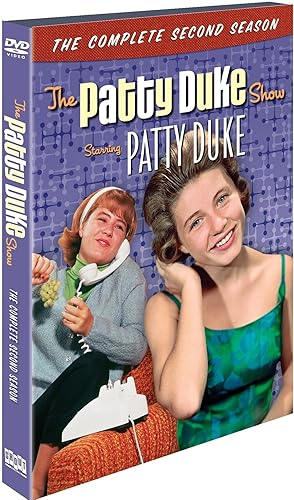
Click to order The Patty Duke Show: The Complete Second Season on DVD:
(Paid link. As an Amazon Associate, the website owner earns from qualifying purchases.)
I wrote an extensive review of the first season of The Patty Duke Show, so if you don’t know the show, increase our unique eyeballs (while getting my dipsomaniac editor off my f*cking back) by clicking on that review. All good now? Thanks (when the monthly readership numbers come in, it’s time to hide out in the supply closet with the closest Bryn Mawr intern).
At the end of my review for the first season of The Patty Duke Show, I wondered if the show would evolve somehow from its beginnings. After all, back during this heyday of network programming, the “if it ain’t broke, don’t fix it” philosophy was in full force, particularly with sitcoms.
The “reliably repeatable experience” for viewers was certainly a goal with the suits and money men who ran the Big Three (creating inevitable clashes with producers, writers, and performers who chafed against the weekly grind of formulaic television). A classic example I always point to is Hogan’s Heroes, a series where episodes from various seasons are almost indistinguishable in their sameness.
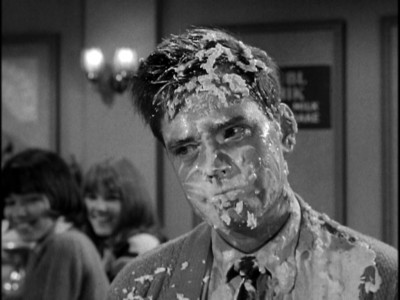
To be clear: I don’t have anything against that way of making television; if a show is good, let it ride. Lucy and Jackie and Red didn’t fundamentally change their formulas, and they made classic television for decades. If The Patty Duke Show stayed exactly the same this second go-around, that just would have meant 36 more charming, funny sitcom episodes to enjoy (36 episodes! Can’t you imagine today’s TV weasels meeting that episode order?!).
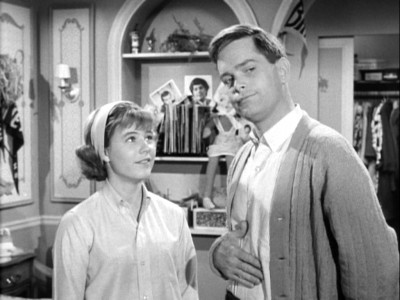
As it is, there are no major shake-ups to the series’ framework this season, but a few changing thematic trends are noticeable (I thought there might be when they introduced a third role for Duke to play―the scheming little Southern-fried mantrap, Cousin Betsy―but she only shows up once here). As with the first season, two main story frameworks dominate: Patty’s dating life, and Patty’s “projects” for school and self-improvement.
In this season, Patty maintains a fairly fluid relationship with Richard. They’re “steadies,” but they do occasionally date others…as long as they don’t break one of their own dates. Clearly, the writers and producers understood that Patty had to remain “free” to momentarily pursue other boys (for variety’s sake), while also making sure she stayed connected with Richard to provide that viewer continuity from week to week.
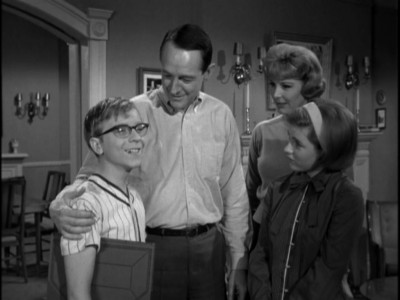
Interestingly, the once severely addle-pated Richard is allowed to “mature” somewhat in these episodes, getting to the point where he not only starts to understand strategy in dealing with the mercuric Patty, but also becomes self-confident enough to “ditch” her when she badly mistreats him. In the opening episode, The Green-Eyed Monster, Richard becomes positively charming―with the help of Martin’s advice―in his wooing-back Patty when she strays to a handsome new suitor (Richard’s gradual transformation into a still-goofy but more adept boyfriend is highlighted by Martin’s grudging acceptance of him this season―Martin even goes as far as saying he likes Richard: a quantum leap from the previous season).
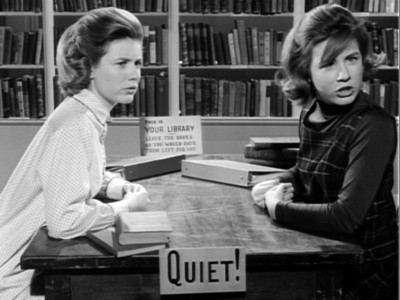
Patty frequently mistreats Richard with her sometimes innocuous, sometimes hurtful fickleness (in Don’t Monkey With Mendel, she even goes so far as to declare Richard genetically inferior to most other males). But Richard isn’t above acting out against Patty, too (another sign that his once-seemingly feeble teen boy brain is developing).
RELATED | More 1960s TV reviews
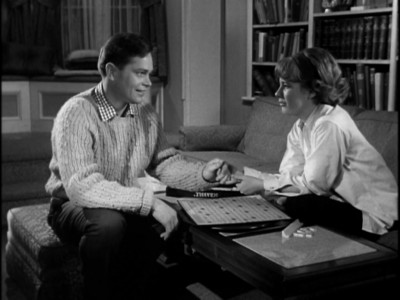
In Patty and the Cut-Rate Casanova, Richard starts to believe the hype doled out by Patty and Cathy about his own prowess at dating, and succeeds in alienating the cousins and another pretty girl he managed to hook. But true to the show’s sweet nature and genuine feel for teen emotions, Richard and Patty are believably reunited (over an appropriately innocent 1965 game of Scrabble®), agreeing to “start over” in their relationship, both a little wiser to each other’s needs.
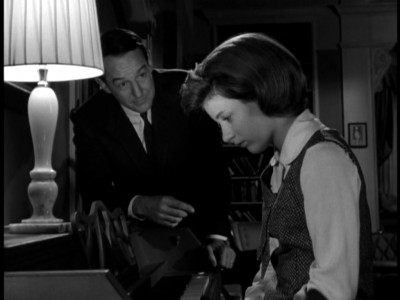
And since teen dating dominates the Lane household, it’s not surprising that shy, retiring Cathy would get in on the game, as well. In my first season review of The Patty Duke Show (you just read it. Remember?), I felt that the outgoing, boy-crazed American teen Patty clearly dominated the show.
However, for this go-around, Cathy is given quite a bit more to do, and Duke is utterly masterful in creating two entirely different characters with just the subtlest changes in voice and gesture. Pitting the cousins against each other more often this season (with a boy usually as the crux of the problem) provides more dramatic and comedic possibilities than just having Cathy bail out Patty as was often done in season one.
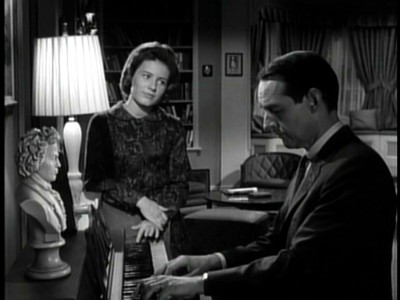
And from this frequent conflict, Cathy becomes a much stronger presence on the show, including thoughtful, funny episodes such as How to Succeed in Romance where she takes disastrous boyfriend-snagging advice from Patty, and Block That Statue, where her kind encouragement unleashes the sculptor in reluctant football player Daniel J. Travanti. She even gets to date Richard in Patty and the Cut-Rate Casanova, giving Patty a needed glimpse into how special Richard really is…for a dolt.
In addition to Patty’s dating, her school and extracurricular pursuits―and their inevitable impact on her family dynamics―anchor most of the other scripts here. In Practice Makes Perfect, one of the funnier outings this season due to some truly inspired low-key panic by William Schallert, Patty decides to become a “culture vulture” and take up a classical instrument: the tuba.
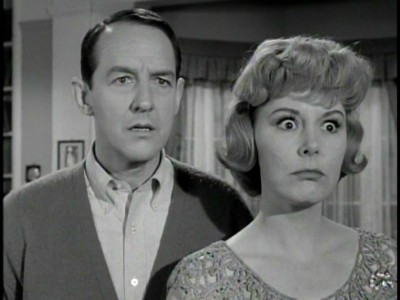
Of course, the well-meaning Patty throws herself into the new venture with abandon…and promptly overdoes it, as her family goes slowly insane from the constant basso profundo blarings of the tuba (Schallert is particularly funny here, casting paranoid glances to the side and jumping with neurasthenic agony when Patty blares the tuba, fatalistically intoning, “There’s nothing anyone can do,” to make her stop).
Patty’s incorporation of herself as a jam-making tycoon (with Cathy’s efforts in the kitchen) seems too close to the first season story where she makes the designer dresses (The Tycoons), but her stint as a wildly unsuccessful advice columnist in Simon Says, her efforts to be an overachieving Student of the Year in Can Do Patty, her raffling-off of Richard in The Raffle, and building a midget racer for Ross in Patty, The Master Builder, all showcase the series’ facility at crafting stories that achieve a nice comedic “build” as Patty becomes hopelessly ensnared in her own overly-ambitious projects (Duke is excellent at getting across first Patty’s enthusiasm, then the growing realization that she’s getting pulled under, then sheer panic, to finally relief when the problem is resolved. She’s a remarkably sure-footed, accomplished actress here).
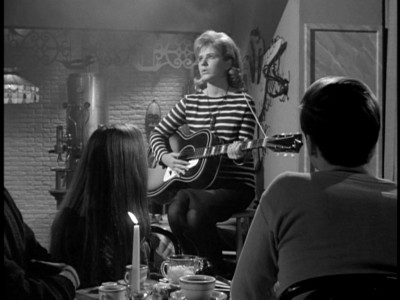
Interestingly, two episodes towards the very end of the season―Cathy, The Rebel and Patty, The Folk Singer―seem to indicate that even in the largely apolitical network sitcom world of 1965, the winds of change were soon going to blow through. In Cathy, The Rebel, a letter to the editor of The Chronicle pits “Martin the Dinosaur” against the teens he castigates in a piece.
However, it’s not Patty, as one might expect, as the letter-writing instigator, but quiet Cathy who believes Martin was wrong in his moral stance (although she didn’t know at first that Martin was the author of the piece). And in Patty, The Folk Singer, Patty and Richard become beats-in-name-only as they bus tables and sweep up at The Pink Percolator coffeehouse―all for the chance for Patty to sing some folk songs―a situation her parents don’t approve of…until they hear her lovely song.
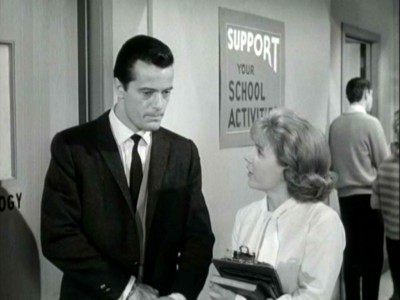
Patty, The Folk Singer is played strictly for laughs, but Cathy, The Rebel aims to send a message, which is does with gentle humor. However, a few other episodes take on a preachy tone that simply doesn’t work here, such as Patty, The Organizer, where Patty becomes a Junior SEIU union thug, or Patty, The People’s Voice, where a JFK-ish candidate who espouses, among other inanities, unbalanced budgets, increased spending, and higher taxes as a moral obligation (remember that a couple of years ago?), fires up Patty’s inner socialist (the villain in the piece is the old guy who wants to lower everyone’s taxes. Thanks, Hollywood douchebag writer).
Luckily, these are few and far between, with the majority of episodes remaining firmly grounded in recognizable dramatic conflicts and surprisingly resonant emotions (the lovely Best Date in Town is a particularly gentle episode, with Schallert and Duke quite tender with each other in a story about a daughter and father realizing how much they love each other).
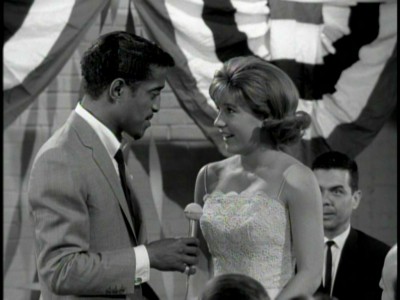
And finally, a roster of notable guest stars crop up this season, indicative of the show’s first season ratings’ success―as well as welcome appearances by a host of New York actors in supporting roles, such as James Coco, Jean Stapleton, Phil Leeds, Alan Manson, David Doyle (perfectly cast as Richard’s father), and Bruce Kirby.
Patty thinks she’s getting married off to Frank Sinatra, Jr. (nicely competent, playing it straight); she performs a disastrous skit with Sal Mineo (who looks a loooong way from Exodus); she chases after Bobby Vinton (stiff and uncomfortable) who she thinks is out to steal Poppo’s job; she discovers “Nigel and Patrick” (Chad & Jeremy manage to cram in three hits: A Summer Song, Yesterday’s Gone, and The Truth Often Hurts the Heart); Robert Goulet makes Patty’s heart flutter when he subs in her science class (Goulet’s always good); and Sammy Davis, Jr. becomes obsessed with playing Patty’s Junior Prom (with a funny cameo by Peter Lawford).
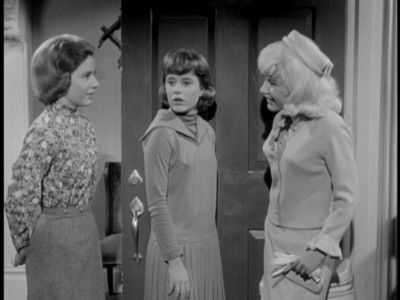
All that star power, however, didn’t contain the ratings’ slide that befell The Patty Duke Show‘s sophomore season. Having hit an impressive 18th for the year during its opening season, it fell a worrying 10 slots to 28th for this 1964-1965.
Perhaps ABC shouldn’t have kept Duke’s lead-in the dying-fast The Adventures of Ozzie & Harriet, switching instead to Duke’s lead-out, the new Shindig, to grab the teens right at 8:00pm. Maybe it was just a case of the novelty of the identical cousins wearing off. It’s difficult to say. But the following year would be the last season for The Patty Duke Show, and the ratings wouldn’t improve.
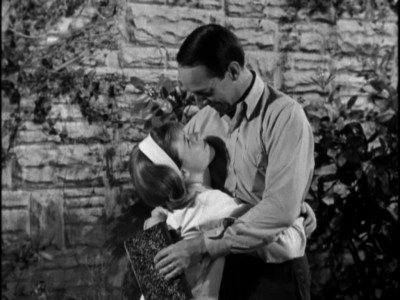
Still…a slight tweaking to the two main themes here―Patty dating and Patty screwing up something―keeps the second season of The Patty Duke Show quite fresh and entertaining, with the cast of pros smoothly finding their rhythm together. Duke is, as always, marvelous, while Schallert, Byron, O’Keefe, and Applegate match her scene for scene.
Solidly constructed, gentle in its humor and surprisingly resonant dramatically, the second season of The Patty Duke Show is another winner from those network days that many of today’s “critics” (most of whom haven’t even seen what they’re criticizing) condescendingly dismiss as “fluff.” Of course The Patty Duke Show isn’t “fluff”―it’s expertly-crafted “fluff.”

Read more of Paul’s TV reviews here. Read Paul’s movie reviews at our sister website, Movies & Drinks. Visit Paul’s blog, Mavis Movie Madness!…but mostly TV.

